Role of Education in Achieving Viskit Bharat Mission
Role of Education in Achieving Viskit Bharat Mission
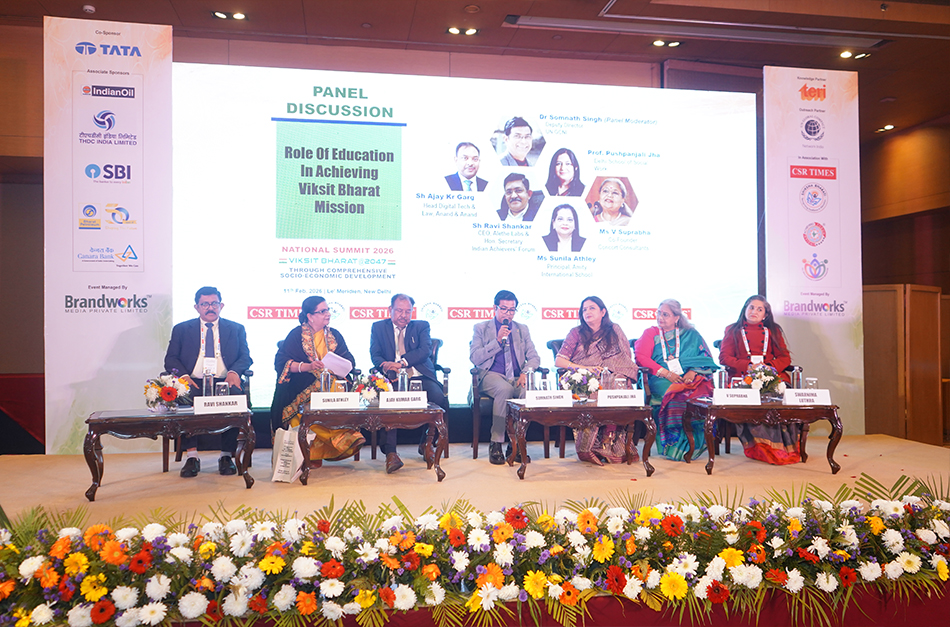
The panel discussion on the Role of Education in Achieving the Viksit Bharat Mission brought together distinguished leaders from academia, law, school education, consulting, and civil society to explore how education can become the cornerstone of India’s journey toward becoming a developed nation.
The session was moderated by Dr Somnath Singh, Deputy Director of United Nations Global Compact Network India, who set the tone by emphasizing that Viksit Bharat is not merely an economic aspiration but a holistic vision encompassing social equity, sustainability, innovation, and ethical governance. He underlined that education must serve as the driving force enabling citizens to contribute meaningfully to national development.
Prof. Pushpanjali Jha from the Delhi School of Social Work highlighted the transformative power of inclusive and value-based education. She stressed that education must go beyond academic excellence to nurture empathy, social responsibility, and community engagement.
Offering a legal and technological perspective, Mr. Ajay Kumar Garg, Head of Digital Tech & Law at Anand & Anand, spoke about the growing intersection of technology, innovation, and regulation. He emphasized the need to equip students with digital literacy, ethical tech practices, and awareness of intellectual property rights to thrive in a knowledge-driven economy.
From the school education standpoint, Ms. Sunila Athley, Principal of Amity International School, underscored the importance of foundational learning, critical thinking, and experiential pedagogy. She noted that nurturing curiosity and character at an early age lays the groundwork for responsible citizenship and leadership aligned with the Viksit Bharat vision.
Adding a corporate and strategic lens, Ms. V Suprabha, Co-Founder of Concort Consultants, highlighted the role of industry-academia collaboration. She advocated for skill-based education, employability enhancement, and sustainability-focused curricula to bridge the gap between learning and real-world demands.
Ms Swarnima Luthra, Principal, ASN Senior Secondary School, noted that fostering creativity, resilience, and a sense of responsibility among students is essential for preparing them to contribute meaningfully to the vision of a developed and progressive India.
Finally, Mr. Ravi Shankar, Hon. Secretary of the Indian Achievers’ Forum, emphasized the importance of mentorship, recognition, and youth empowerment in fostering innovation and national pride.
In conclusion, the discussion underscored that education is the most powerful catalyst in advancing the Viksit Bharat mission. When rooted in strong values, strengthened by technological integration, and aligned with evolving industry and societal needs, education becomes a transformative force for inclusive and sustainable growth. The panel emphasized that collaboration among academia, industry, government, and civil society is essential to bridge skill gaps, foster innovation, and nurture responsible leadership. By investing in holistic learning, digital empowerment, and equitable access, India can cultivate a generation capable of driving economic progress while upholding social responsibility, ultimately shaping a resilient and developed nation.